
 ZHANG CHENGLIANG/CHINA DAILY
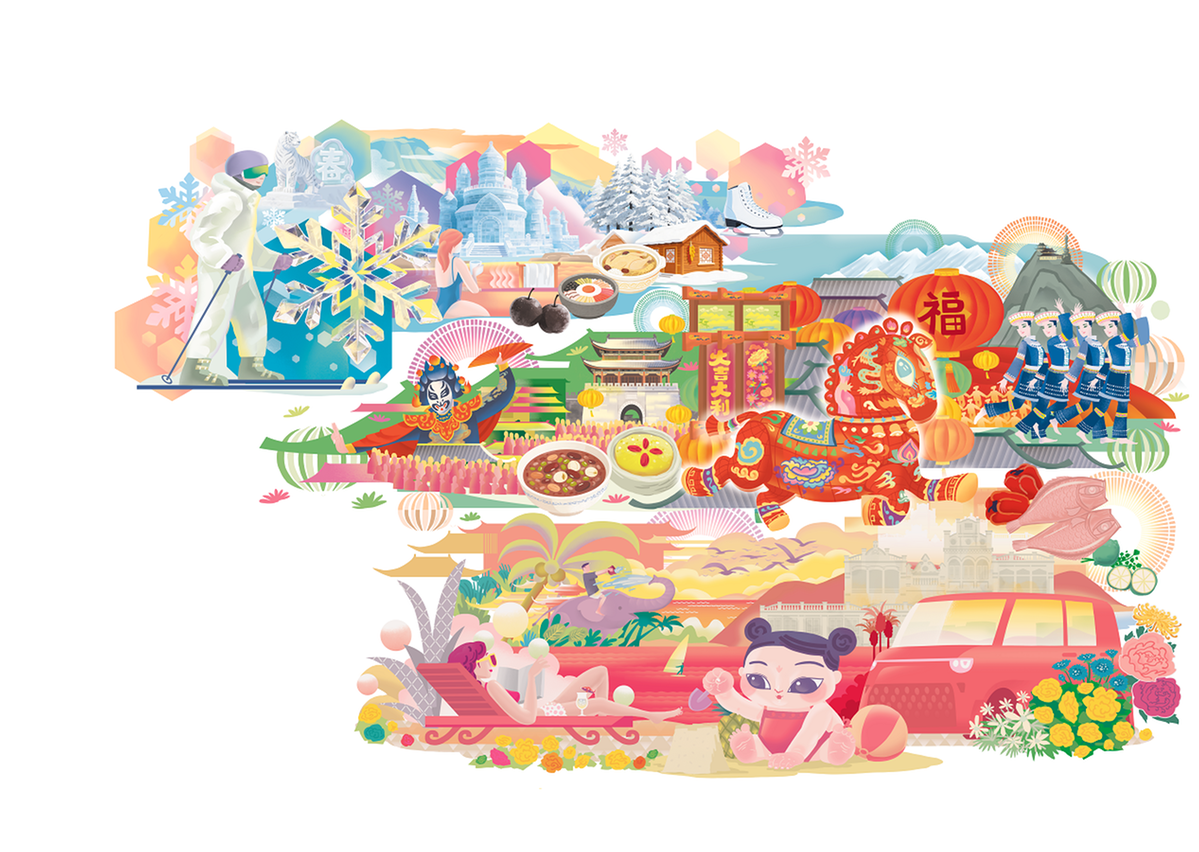
Spring Festival is the same yet different, shaped by where you come from — not only within China, but around the world. For most Chinese people, it’s first and foremost about returning to hometowns for family reunions. For many expats, for whom returning to their home countries during this time often proves impractical, it’s a chance to explore more of China outside the cities in which they work and live. Some foreigners run toward the sun to escape the cold. Some dash through the snow to embrace deep winter experiences. Yet others seek a Goldilocks balance, pursuing cool destinations that are not too hot, not too cold, but just right — and just as fun. China Daily looks at some of the top spots that expats visit to enjoy the seasonal festivities, and go further in their explorations of the country and its culture.
COLD | HEILONGJIANG
Entering a frozen wonderland
No matter the season, merely mention Heilongjiang province, and ice and snow are the first things that come to mind for many.
The province truly embodies winter during its world-famous ice-lantern festival in the capital, Harbin. Multistory buildings made of packed snow and populated with technicolor ice sculptures appear as a fantastical frozen kingdom. The Harbin Ice-Snow World is a 1.2-square-kilometer realm that seems larger than life — and the park that contains it. Here, 400,000 cubic meters of frozen water are transformed into virtually any and every kind of noun imaginable.
These frosty forces continue to reign over the first days of Spring Festival.
While ancient ice lanterns were filled with candles, „ice gourds“ today brim with slushy booze. Hollowed-out melons are filled with baijiu (sorghum liquor) and fruit juice, and frozen, so the slurry sloshes inside its own crackling, edible, iced „cup“.
Those seeking winter condensed into its purest form make the journey to „China’s North Pole“, Mohe. Here, you can witness the ethereal aurora borealis dance to the symphony of silent stars over Beiji village or feed the namesake ruminants of Reindeer Village.
In Mudanjiang, you can wander through the enchanting snow-draped cottages of China Snow Town, a settlement that appears partly like Northern Europe and partly like a fairy tale, yet is entirely and authentically Chinese.
Visitors can observe the majestic prowl of over 700 Siberian tigers and other big cats at Harbin’s Siberian Tiger Park, or swoosh down the slopes of Yabuli, which ranks among Asia’s premier ski resorts.
Or, they can steep in a sublime contrast — soaking in outdoor hot springs in Heihe or Daqing, where steam rises to meet the falling snow around the point where liquid and solid water meet and transform into vanishing wisps of vapor.
Heilongjiang shows winter may be something to escape to, rather than from, especially to appreciate its end and the start of spring.
COLD | JILIN
A crystallized northern kin
Neighboring Jilin province is akin to Heilongjiang’s cousin in many respects, including how its identity crystallizes around winter in more than mere imagination.
Its capital, Changchun, likewise stages an ice-and-snow fest. It also hosts the Tiandingshan Ski Resort and the Wanda Indoor Ski Resort, which opened in late December to provide year-round experiences with a constant temperature of — 6 C. And Jilin city is home to another of the continent’s biggest ski resorts, Beida Lake, with 74 ski trails stretching 80 kilometers in total and augmented-reality navigation screens.
The province’s most distinctive seasonal phenomenon is Jilin city’s rime, which is listed among China’s Four Great Natural Wonders. An unfrozen segment of the Songhua River exhales mist that clings to the willow branches that cascade toward its banks, rendering countless frosted plumes. The city even offers a real-time rime-viewing service you can check on your phone.
Further off the beaten path, visitors can experience the millennium-old tradition of winter angling, catching fish that leap from the surface of Chagan Lake before dining on them at farmhouse restaurants near the shore.
The Changbai Mountain Snow Ridge bristles with lone pines and huddled thickets of birch. The climate here forges such natural formations as „snow mushrooms“ and snow caves. People ride horse-drawn sleds and snowmobiles through this incredible landscape, which is home to a wildlife park inhabited by sika and roe deer, and wild sable. It hosts yet another ice fest at its Ice and Snow Fantasy Park, where imagination takes shape in frozen water.
Visitors can sample such ethnic Korean delicacies as soybean-paste soup, glutinous rice cakes and stone-pot bibimbap year-round. They can enjoy Chinese New Year specialties like sweet-and-sour pork, snowflake red-bean paste, iron-pot stew, kimchi with pork and blood sausage and — a newer innovation that has become a recent addition to tradition — frozen-pear coffee.
Travelers who make the trip during Chinese New Year may discover that extreme cold can be a source of creation rather than limitation.
COOL | GUIZHOU
Listening to, feeling and sharing a silent ‘song of ice and fire’
Wintertime in Guizhou province is a time and place where people move to the silent „song of ice and fire“ (bing yu huo zhi ge). The province’s winter warmth is not just geothermal but communal, and not just heard but felt.
Liupanshui hosts low-latitude, high-altitude ski venues where temperatures dip their toes just below freezing, creating conditions noticeably milder than many northern resorts’. Trail temperatures hover around — 2 C — just brisk enough to feel refreshing but not frigid enough to sting your skin. The province’s temperature is expected to average 7.1 C this winter.
Guizhou is often thought of as a summer resort, however, local people come out in full force to observe Spring Festival traditions. Its iconic New Year snack is a sweet treat called xiaomizha, a steamed cake resorts’. Trail temperatures hover around — 2 C — just brisk enough to feel refreshing but not frigid enough to sting your skin. The province’s temperature is expected to average 7.1 C this winter.
Guizhou is often thought of as a summer resort, however, local people come out in full force to observe Spring Festival traditions. Its iconic New Year snack is a sweet treat called xiaomizha, a steamed cake made of yellow millet, lard and brown sugar.
Villagers in Anshun’s Tunpu stage processions honoring the village’s guardian deity, Wang Gong. They march along flagstone streets, pausing at every doorstep to offer blessings and detonating an armory’s worth of firecrackers around the 18th day of the first month on the traditional calendar. Some wear masks while performing Dixi Opera.
People from the Miao ethnic group perform tiaodong (cave dances) with thousands of townsfolk bouncing along in processions to the breathy melodies of lusheng reed pipes and the clanging rhythm of gongs.
That said, in almost any city throughout Guizhou, you may stumble upon a roadside concert performed by local bands and singers, who sometimes invite passersby to join the show.
COOL | SICHUAN
Tracing tradition through mountains and stories
Langzhong Ancient City in Sichuan’s Nanchong is certainly a cultural cradle and perhaps the oldest living museum of Spring Festival.
The Zigong Lantern Festival, Chengdu’s temple fair and laba porridge dished out at the capital’s Wenshu Monastery are hallmarks of Spring Festival celebrations, Sichuan style.
Zigong’s lanterns are among the country’s most illustrious and have become synonymous with the city since the Tang Dynasty (618-907).
Chengdu’s downtown temple fair is staged at the Temple of Marquis Wu and the nearby ancient Jinli Street. It presents Three Kingdoms (220-280) culture, lantern displays and performances of Sichuan Opera, including the genre’s distinctive stunts — face-changing, fire-breathing and lantern-rolling.
Sichuan’s laba tradition is said to date back two millennia. For three centuries, people have lined up at Wenshu Monastery for a free bowl brimming with 14 ingredients, including red dates and goji berries.
Travelers can brave the crowds at iconic sites like Sichuan’s panda parks, the Sanxingdui ruins and Leshan’s Giant Buddha.
Or, they may venture further afield to one of southern China’s largest ski destinations, the Xiling Snow Mountain, about 100 km from Chengdu. Xiling features snowmobiling, snow tubing and sledding, just 15 km from the Huashuiwan hot springs, which are believed to offer healing properties.
Visitors can also ski and soak on the slopes and springs of Mount Emei, one of Chinese Buddhism’s four sacred peaks, in Leshan. They can blast down from Emei’s crown at the Leidongping Ski Ranch and recharge in geothermal radon and sulfur pools at the mountain’s foot.
Ice climbers clip on crampons and head to the Siguniang Mountains’ Shuangqiao Valley in the Aba Tibetan and Qiang prefecture. Over 100 waterfalls freeze into icefalls and walls when the temperature drops.
Less-crowded destinations during Chinese New Year include the nearly 1,400-year-old Anren Ancient Town, which features Anren Old Street, Liu’s Manor Museum and the Jianchuan Museum Cluster.
The Jianchuan Museum houses more than 10 million artifacts, including around 7,000 national-level relics.
Further still off the beaten track, one of the world’s last operating narrow-gauge passenger steam trains chugs through Qianwei county. Visitors can hop aboard for the two-hour round trip, veering along 108 bends and clacking through six tunnels on the nearly 20-km-long Bashi Railway built in 1958 to transport coal.
In Sichuan, a Spring Festival journey becomes one of immersion, where ancient customs and unexpected adventures create a uniquely „cool“ feel.
HOT | YUNNAN
Revelling in eternal, gentle spring
Weather is a big plus that adds to Yunnan province’s value as a Spring Festival destination. Average winter temperatures range from 10 to 20 C throughout the southwestern province, and are expected to hover between 16 and 26 C in the Honghe Hani and Yi autonomous prefecture during the first days of Chinese New Year.
Arrivals typically start their travels from the provincial capital, Kunming, known as the „City of Eternal Spring“. You can snap photos of black-headed gulls at Haigeng Dam, against the backdrop of the Western Hills. These prominences are also known as the „Sleeping Beauty Hills“ because their peaks create the contour of a woman lying beside Dianchi Lake, the silhouette of her upturned face traced by the summits, and the slopes resembling her hair cascading into the water.
Tourists can explore Guandu Ancient Town and Dounan Flower Market, where they can not only buy but also eat the blooms, as restaurants in the neighborhood serve edible blossoms with many dishes.
Travelers can then head to Honghe’s Mile city to tour the Dongfengyun Art Town’s redbrick buildings, stroll through Taipinghu Forest Park’s tulip fields and literally reflect on life in Honghe Water Town, where the lake’s surface ripples with inverted projections of street scenes.
From Mile, you can continue to the prefecture’s Jianshui to stroll through the Zhu Family Garden and absorb its regional horticultural ambiance, visit the ancient city and hop aboard the narrow-gauge rail to view pastoral scenery.
About 45 minutes from Jianshui in Honghe is Shiping, where you can visit the ancient city’s lively Guanyin Temple Alley, the noted scholar and historian Yuan Jiagu’s former residence, and Yilong Lake.
Here, in the province where the capital is the „City of Eternal Spring“, the festival finds its ideal temperate zone — a climate of celebration that’s perpetually mild and vibrant in a land that always embodies gentle renewal.
HOT | HAINAN
Welcoming the new year in southern warmth
A Hainanese saying goes, „The chopping board never rests on New Year’s Eve.“
No Spring Festival celebration in China’s southernmost province is complete without chicken. After Mid-Autumn Festival, rural families start raising free-range fowl to boil for New Year’s Eve dinner.
Families set out a feast, light incense and candles, and the head of the household leads the family in bowing in respect to their ancestors. In rural areas, paper money is burned, and liquor and dishes are offered before ancestral portraits in solemn ceremonies.
The provincial capital, Haikou, is a hub for Chinese New Year shopping. Markets offer everything from traditional sweets and pastries to dried goods and seafood. Commissioning streetside calligraphers to handwrite couplets customizes the celebrations.
Haikou’s residents traditionally eat vegetarian meals, like hotpot, on New Year’s Day. In ancient times, this was considered a commitment to nonviolence for the upcoming year. Today, it’s considered a healthy start to the year.
In Wenchang city, guests bring their own firecrackers when visiting relatives. It’s believed that more fireworks bring more blessings and popularity.
In central Hainan, families from the Li ethnic group enjoy Shanlan rice liquor, sing folk songs and bamboo-pole dance to celebrate the previous year’s harvest until the fifth day of Chinese New Year. People of the Li ethnic group also believe that eating chicken on Chinese New Year brings good luck.
The „sealing the rice jar“ ritual marks the prelude to the Li group’s holiday. Around the middle of the 12th month of the traditional calendar, matriarchs choose an odd-numbered auspicious date on which to fill their rice jars after the third cockcrow after sunrise. They then cap these containers with red paper. The jars are reopened on the 15th day of the first month of the Chinese calendar, and the rice is cooked for the family.
Cured sausages, preserved meats and dried red snapper are essential dishes for Hakka families’ New Year celebrations. There’s a saying, „no feast is complete without fish“, in Danzhou city, where families who live by the coast use fish, especially red snapper, as sacrificial offerings. A whole dried red snapper symbolizes good fortune, prosperity and abundance.
But visitors don’t need fish to find abundance and fortune during their Spring Festival explorations in Hainan or beyond. From the country’s southern edge to its northern tip, for many expats, such journeys are often less about returning home than discovering it. And that’s something worth celebrating.
 Online Scan to see more of China Bound.
Нашия източник е Българо-Китайска Търговско-промишлена палaта